Olympic Weightlifter Lifts but the Judges Dont Count It So He Does It Again
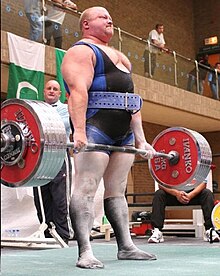 The deadlift being performed by 2009 IPF Globe Champion Dean Bowring | |
| First played | 20th century or earlier, U.s. |
|---|---|
| Characteristics | |
| Type | International Powerlifting Federation (IPF) weight classes:
|
| Presence | |
| Olympic | No |
| Paralympic | Aye |
| World Games | 1981 – present |
Powerlifting is a force sport that consists of three attempts at maximal weight on 3 lifts: squat, demote printing, and deadlift. Every bit in the sport of Olympic weightlifting, information technology involves the athlete attempting a maximal weight single-lift effort of a barbell loaded with weight plates. Powerlifting evolved from a sport known as "odd lifts", which followed the same iii-attempt format just used a wider variety of events, akin to strongman contest. Somewhen odd lifts became standardized to the current three.
In competition, lifts may be performed equipped or un-equipped (typically referred to equally 'classic' or 'raw' lifting in the IPF specifically). Equipment in this context refers to a supportive bench shirt or squat/deadlift accommodate or briefs. In some federations, articulatio genus wraps are permitted in the equipped only not un-equipped division; in others, they may be used in both equipped and un-equipped lifting. Weight belts, articulatio genus sleeves, wrist wraps, and special footwear may also be used, but are not considered when distinguishing equipped from un-equipped lifting.[ane]
Competitions take place across the world. Powerlifting has been a Paralympic sport (bench press only) since 1984 and, under the IPF, is also a Earth Games sport. Local, national and international competitions have likewise been sanctioned by other federations operating independently of the IPF.
History [edit]
Early history [edit]
The roots of powerlifting are found in traditions of forcefulness training stretching back as far as ancient Greek and ancient Persian times. The idea of powerlifting originated in ancient Greece, as men lifted stones to evidence their strength and manhood.[2] Weightlifting has been an official sport in the Olympic Games since 1896.[2] The mod sport originated in the United Kingdom and the United States in the 1950s. Previously, the weightlifting governing bodies in both countries had recognized various "odd lifts" for competition and record purposes. During the 1950s, Olympic weightlifting declined in the U.s., while force sports gained many new followers. People did non like the Olympic lifts Make clean and Press, Snatch and Make clean and Wiggle.[3] In 1958, the National Weightlifting Commission of the Amateur Athletic Marriage (AAU) decided to begin recognizing records for odd lifts. A national championship was tentatively scheduled for 1959, but never happened. The kickoff genuine national "meet" was held in September 1964 under the auspices of the York Barbell Company. Ironically, York Barbell owner Bob Hoffman had been a longtime adversary of the sport, simply his visitor was now making powerlifting equipment to make upwards for the sales it had lost on Olympic equipment.
In 1964, some powerlifting categories were added to the Tokyo Paralympic Games for men with spinal cord injuries. More than categories of lifting were added as time went past. In the 2000 Paralympic Games in Sydney, women were finally invited to participate in powerlifting. Finally, both men and women were immune to compete in all 10 weight classes of powerlifting.[ii]
During the tardily 1950s, Hoffman'south influence on Olympic lifting and his predominately Olympic-based magazine Strength and Health were beginning to come under increasing pressure from Joe Weider'south organization. In lodge to gainsay the growing influence of Weider, Hoffman started another mag, Muscular Development, which would be focused more on bodybuilding and the fast-growing interest in odd elevator competitions. The mag's first editor was John Grimek. During the tardily 1950s and early on 1960s, various odd lift events gradually developed into the specific lifts of the bench press, squat, and deadlift, and they were lifted in that order. Hoffman became more than and more influential in the development of this new lifting sport and organized the Weightlifting Tournament of America in 1964, effectively the offset USA National championships. In 1965, the kickoff named U.s. National Championships were held. During the aforementioned flow, lifting in United kingdom of great britain and northern ireland also had factions. In the belatedly 1950s, because members of the ruling torso (BAWLA, the British Apprentice Weight Lifters' Association) were only interested in the development of Olympic lifting, a breakaway system called the Society of Amateur Weightlifters had been formed to cater for the interests of lifters who were not particularly interested in Olympic lifting.
Although at that time at that place were 42 recognized lifts, the "Force Set" (biceps gyre, bench press, and squat) before long became the standard competition lifts, and both organizations held Championships on these lifts (as well as on the Olympic lifts) until 1965. In 1966, the Society of Amateur Weightlifters rejoined BAWLA and, in club to fall into line with the American lifts, the biceps curlicue was dropped and replaced with the deadlift. The beginning British Title was held in 1966. During the belatedly 1960s and at the beginning of the 1970s, various friendly international contests were held. At the same time, in early Nov of each yr and to commemorate Hoffman's altogether, a prestigious lifting contest was held. In 1971, information technology was decided to brand this effect the "Globe Weightlifting Championships". The event was held on the morning of half-dozen Nov 1971, in York, Pennsylvania. There was no such thing as teams and thus the event consisted of a large grouping of American lifters, 4 British lifters, and i lifter from the West Indies. All of the referees were American. Weights were in pounds. Lifting lodge was "rising bar", and the get-go lift was the bench press. There was no such matter as a demote shirt or squat suit, and diverse interpretations were held regarding the use and length of knee joint wraps and weightlifting belts. The IPF rules organization did non exist yet, nor had earth records been established.
Considering of the lack of formalized rules, some disputes occurred.
There was no 52 kg form, 100 kg class, or 125 kg class.
At the outset World Championships, i of the American super-heavyweights, Jim Williams, benched 660 lbs on his second attempt (no shirt), and almost locked out 680 lbs on a third attempt. Some other notable lifts were Larry Pacifico benching 515 lbs in the 90 kg grade, John Kuc deadlifting 820 lbs, and Vince Anello attempting 800 lbs at xc kg.[4] Hugh Cassidy and Williams both totalled 2,160 lbs, only Cassidy got the win because of a lower bodyweight in the Super heavyweight segmentation.
In 1972, the 'second' AAU World Championships were held, this fourth dimension over two days – 10 and xi November. This time in that location were 8 lifters from Great Britain (two of whom, Ron Collins and John Pegler, did stints as Referees), six Canadians, two Puerto Ricans, three Zambians, and one from the Due west Indies. With 67 lifters in all, the other 47 were Americans. Lifts were measured in pounds, the demote press was the kickoff lift, and there were nevertheless no suits, power belts, or knee wraps. New Zealand's Precious McKenzie won his 'second' world title totalling 550 kg at 56 kg. Mike Shaw 'lost' his world title, which he had won the previous year, to American Jack Keammerer. Ron Collins fabricated up for his 'bomb' on the bench in 1971 and stormed to the 75 kg title. Pacifico won against another American, Mel Hennessey, at 110 kg, both with enormous benches of 260 kg and 255 kg. At Super (over 110 kg) John Kuc beat out Jim Williams with an incredible 2,350 lbs full (raw). Kuc squatting 905 lbs for a tape squat and attempting a 397½ (875 lbs) deadlift again, and Williams benching a massive 307½ (675 lbs) – the greatest demote press ever at the time, before just missing with 317½ (700 lbs).[5] Jon Cole, the Super heavyweight winner of the The states Senior Championships 1972 and holder of the greatest full at that time with i,075 kg (2,370 lbs), didn't prove up to take on Kuc.
IPF and subsequently [edit]
The International Powerlifting Federation was formed immediately after the contest and and so none of the lifts could be yet registered equally official globe records. The 1973 Worlds was besides held in York. This time there were only 47 entrants: one Swedish, 1 Puerto Rican (Peter Fiore, who was lifting for Zambia), 2 Canadians, 1 West Indian, eight British, and the rest Americans. The officiating became increasingly international and included Tony Fitton and Terry Jordan from Britain, a Canadian, and a Zambian. American Bob Crist was the IPF President and another American, Clarence Johnson, was vice-president. 1973 was the showtime time that the lifts were done in the social club now recognized – squat, bench press, deadlift (although still lifting in pounds). Precious Mackenzie won his tertiary World title, easily beating American teenager Lamar Gant. 1974 was the get-go time that teams had to be selected in advance. With 74 entrants, this was the largest Worlds and so far. The 52 kg class was introduced, and nine lifters entered. In 1975, the Earth Championships was held exterior America for the kickoff time, at the boondocks hall in Birmingham, hosted by Vic Mercer. 82 lifters entered. Unusually for a competition, the super-heavyweights lifted first. This was because the tv company filming the consequence was simply interested in filming the "big guys". Hoffman sent over tons of equipment for this contest and did not accept information technology dorsum, and local legend says information technology is all however being used in Birmingham and the wider Due west Midlands region.
The establishment of the IPF in 1973 spurred the establishment of the EPF (European Powerlifting Federation) in 1974. Since information technology was closely associated with bodybuilding and women had been competing as bodybuilders for years, the new sport was opened to them very apace. The offset U. S. national championships for women were held in 1978 and the IPF added women's competition in 1979. In the Us, the Amateur Sports Human activity of 1978 required that each Olympic or potential Olympic sport must have its ain national governing body past November 1980. As a result, the AAU lost control of virtually every amateur sport. The USPF was founded in 1980 every bit the new national governing torso for American powerlifting. Soon, controversy over drug testing would crusade powerlifting to splinter into multiple federations. In 1981, the American Drug Free Powerlifting Association (ADFPA), led by Brother Bennett, became the get-go federation to break away from the USPF, citing the demand to implement effective drug testing in the sport.[6] Meanwhile, the IPF was moving towards adopting drug testing at international meets, and requiring fellow member nations to implement drug testing at national meets equally well. In 1982, drug testing was introduced to the IPF men'southward international championship, although the USPF championships that year did non accept drug testing.[7]
The IPF's push for drug testing was resisted by some American lifters, and in 1982 Larry Pacifico and Ernie Frantz founded the American Powerlifting Federation (APF), which advertised its categorical opposition to all drug testing.[vi]
In 1987, the American Powerlifting Association (APA) and World Powerlifting Brotherhood (WPA) were formed past Scott Taylor. The APA and WPA offering both drug tested and non-tested categories in most of their competitions. As of 2022 the WPA has l+ chapter nations.
Ultimately, the USPF failed to conform to IPF demands and was expelled from the international body in 1997, with the ADFPA, now named USA Powerlifting (USAPL), taking its place.[8] Despite the trend towards more than and more federations, each with their ain rules and standards of operation, some powerlifters have attempted to bring greater unity to the sport. For example, 100% RAW promoted unequipped competition and merged with some other federation, Anti-Drug Athletes United (ADAU), in 2013.[9] The Revolution Powerlifting Syndicate (RPS), founded by Factor Rychlak in 2011, might also be considered a move towards greater unity, as the RPS breaks the tradition of charging lifters membership fees to a specific federation in add-on to entry fees for each competition.[10] Also, some meet promoters have sought to bring together height lifters from different federations, outside existing federations' hierarchy of local, regional, national and international meets; a prominent example of this is the Raw Unity Meet (RUM), held annually since 2007.[11]
Developments in equipment and rules [edit]
As new equipment was developed, information technology came to distinguish powerlifting federations from i another. Weight belts and articulatio genus wraps (originally simple Ace bandages) predated powerlifting, only in 1983 John Inzer invented the first piece of equipment singled-out to powerlifters—the bench shirt.[12] Demote shirts and squat/deadlift suits (operating on the aforementioned principle) became ubiquitous in powerlifting, but only some federations adopted the latest and most supportive canvass, denim, and multiply polyester designs, while others such as the IPF maintained more restrictive rules on which supportive equipment could exist used.[xiii] The Monolift, a rack in which the bar catches swing out and eliminate the walkout portion of the squat, was invented by Ray Madden and first used in competition in 1992.[fourteen] This innovation was adopted by some federations and forbidden in others. Other inventions included specialized squat bars and deadlift bars, moving away from the IPF standard of using the aforementioned bar for all iii lifts.
The rules of powerlifting accept also evolved and differentiated. For example, in ADFPA/USAPL contest, the "press" control on the demote printing was used, not used,[15] and and so used again, following a 2006 IPF motion to reinstate this rule.[16] IPF rules likewise mandate a "kickoff" command at the first of the bench press. Many other federations, for instance the Natural Athlete Force Clan (NASA), accept never used the "start" command.[17] As a further example of diversifying rules of performance, in 2011 the Southern Powerlifting Federation (SPF) eliminated the "squat" command at the beginning of the squat.[18] Some federations too now allow the sumo variation of the deadlift, which varies with the anxiety being considerably wider apart and some tension taken off the lower spine being taken up past the legs. Many communities and federations do not class the sumo variation as a technical deadlift.[19]
U.s.a. Powerlifting Controversy [edit]
In 2019, USA Powerlifting drew controversy when it deviated from internationally harmonized practices to impose a full ban on all female transgender athletes as well as all male transgender athletes undergoing hormone replacement therapy. Powerlifting published a 'Transgender Participation Policy' based on a paper published by Kris Hunt, an emergency doctor from St Vincent's Emergency Infirmary, Indianapolis with no qualifications every bit a sports endocrinologist. Powerlifting'due south policy provides:
"While the term discrimination is used to take hold of the attention of the public, it is almost oft misused. We are a sports organization with rules and policies. They apply to anybody to provide a level playing field. We accept restriction [sic] such as age eligibility, who can compete as at our national events and so on. No, you are not discriminated against because you are a xl-yr-erstwhile higher pupil that is non allowed to compete at Collegiate Nationals. No, we are not discriminating confronting your 7-yr-old daughter by not letting her compete. It is simply the rules of this sport that all must be follow if we are to be fair playing field [sic]. Another example, males are not allowed to utilise testosterone and to do then provides him an reward."
[20]
Powerlifting The states's publication appeared to be more ideological than scientific, claiming "The exclamation of gender choice, although legal to change in parts of the world, does not erase the dimorphic differences of sex, formalized at nascency..." The paper appeared to overlook several robust, peer reviewed studies showing that gender based advantages are clearly mitigated when (a) transgender men maintain testosterone serum levels in the good for you male person range, and (b) transgender women accept undergone at least two years of testosterone suppression. Instead, Powerlifting'south written report cited various studies of mice or athletes who are non transgender. Powerlifting's policy too contrasted with the International Olympics Committee 'Framework on Not-Discrimination' which provides that "Eligibility criteria should be established and implemented fairly and in a manner that does not systematically exclude athletes from competition based on their gender identity, physical advent and/or sexual activity variations. Provided they see eligibility criteria.... athletes should be allowed to compete in the category that best aligns with their self-adamant gender identity.".[21] CJ Jones from Knuckles University published a 16-page refutation of Dr Hunt's written report and the Powerlifting USA policy, calling it "...emblematic of the current trans-exclusionary attitude present in sports."[22]
In November 2021, USA Powerlifting was expelled from the International Powerlifting Federation over some of its policies.[23] On January xiv, 2021, female transgender weightlifter JayCee Cooper launched a discrimination lawsuit against USA Powerlifting in the Commune Court of Minnesota.[24]
Supportive equipment [edit]
In powerlifting, supportive equipment refers to supportive shirts, briefs, suits, and sometimes genu wraps made of materials that store elastic potential free energy and thereby assist the three lifts contested in the sport: squat, demote press and deadlift.[25] Some federations allow single ply knee sleeves, which contestants tin put on and off by themselves, and wraps for wrists in raw competition, while some don't and in that location are as well some federations that agree raw records with and without wraps similar GPA. Straps are also used, as help with deadlift in case of a weak grip only are not immune by any federations in official competitions. A chugalug is the simply supportive equipment that is allowed by all federations in raw contest. The use of supportive equipment distinguishes 'equipped' and 'un-equipped' or 'raw' divisions in the sport, and 'equipped' and 'unequipped' records in the competition lifts. The broad differences between equipped and unequipped records in the squat and bench suggest that supportive equipment confers a substantial reward to lifters in these disciplines.[26] This is less evident in the case of the deadlift, where the lack of an eccentric component to the lift minimizes how much elastic free energy tin be stored in a supportive accommodate. Supportive equipment should not exist dislocated with the equipment on which the lifts are performed, such every bit a bench printing bench, conventional or monolift represent squat or the barbell and discs; nor with personal accessories such equally a weightlifting belt that may allow greater weight to be lifted, but past mechanisms other than storing elastic energy. Chalk is commonly used by lifters to dry the easily, especially to reduce the chance of folding and pinching of skin while gripping the deadlift. Chalk can besides be added to the shoulders for squatting and on the dorsum for bench pressing to reduce sliding on the bench.[27]
Principles of operation [edit]
Supportive equipment is used to increase the weight lifted in powerlifting exercises.[26] [28] [29] A snug garment is worn over a joint or joints (such as the shoulders or hips). This garment deforms during the downward portion of a bench press or squat, or the descent to the bar in the deadlift, storing elastic potential energy.[30] On the upwardly portion of each lift, the rubberband potential energy is transferred to the barbell equally kinetic energy, aiding in the completion of the lift.[25] [31] Some claim that supportive equipment prevents injuries by compressing and stabilizing the joints over which it worn.[31] For instance, the bench shirt is claimed to support and protect the shoulders.[26] Critics point out that the greater weights used with supportive equipment and the equipment's tendency to alter the design of the movement may compromise safety, as in the instance of the bar moving towards the head during the upward portion of the shirted bench press.[32]
Material and construction [edit]
Different materials are used in the structure of supportive equipment. Squat suits may be made of varying types of polyester, or of canvass. The latter fabric is less elastic, and therefore considered to provide greater 'stopping power' at the bottom of the motion merely less assist with the rising.[29] Demote shirts may exist made of polyester or denim,[28] where the denim once again provides a less-rubberband alternative to the polyester. Knee wraps are fabricated of varying combinations of cotton fiber and elastic.[33] Supportive equipment can be constructed in unlike means to adjust lifters' preferences. A squat or deadlift suit may exist constructed for a broad or a narrow stance; and a bench shirt may be constructed with 'straight' sleeves (perpendicular to the trunk of the lifter) or sleeves that are angled towards the abdomen. The back of the bench shirt may be closed or open, and the back panel may or may non be of the same cloth as the front of the shirt. Similarly, 'hybrid' squat suits can include panels made from canvas and polyester, in an effort to combine the strengths of each material. When ii or more panels overlay 1 another in a slice of supportive equipment, that equipment is described as 'multi-ply', in contrast to 'single-ply' equipment made of one layer of material throughout.[29]
Raw powerlifting [edit]
Unequipped or "raw" (often styled as RAW) or archetype powerlifting has been codified in response to the proliferation and advocacy of demote shirts and squat/deadlift suits. The AAU first began its raw division in 1994 and the term "raw" was coined by Al Siegal, who afterward formed the ADAU in 1996. The 100% RAW federation was founded in 1999;[34] within a decade, many established federations came to recognize "raw" divisions, in addition to their traditional (open) divisions permitting single-ply or multi-ply equipment. RAW during this time frame, however, was looked upon every bit a beginners stage by the aristocracy lifters in powerlifting. In Jan 2008, the Raw Unity Meet (simply known as "RUM") was formed by Eric Talmant and Johnny Vasquez. It was a crucial contest that gathered the best lifters nether ane roof regardless of gear worn to compete without equipment. Brian Schwab, Amy Weisberger, Beau Moore, Tony Conyers, Arnold Coleman and Dave Ricks were among the first aristocracy lifters to remove their equipment and compete raw. United Powerlifting Association (UPA) established a standard for raw powerlifting in 2008,[35] and USAPL held the first Raw Nationals in the aforementioned year.[36] Eventually, IPF recognized raw lifting with the sanction of a "Classic Unequipped World Cup" in 2012 and published its own gear up of standards for raw lifting.[37] Past this time, the popularity of raw lifting had surged to the point where raw lifters came to predominate over equipped lifters in local meets.[38] [39] Note that the IPF's use of the discussion 'classic' to describe raw powerlifting is contrary to almost other powerlifting federations' utilise of the word to differentiate betwixt 'classic raw' and 'modern raw': classic raw is still unequipped but allows the use of knee wraps, while modern raw allows knee sleeves at nigh. The IPF does non allow knee wraps in its unequipped competitions and would thus exist considered 'modern raw', but the IPF does not recognize the discussion 'raw.'
The use of knee sleeves in unequipped powerlifting has brought about much debate as to whether certain neoprene knee sleeves can actually assist a lifter during the squat. Some lifters purposely wear knee joint sleeves that are excessively tight and have been known to use plastic bags and take others to assist them get their knee sleeves on. This led to the IPF mandating that lifters put on their genu sleeves unassisted.[40]
Equipped powerlifting [edit]
Equipped lifters compete separately from raw lifters. Equipped lifters will wear a squat accommodate, knee joint wraps, a bench shirt, and a deadlift conform. These four things are what separate equipped lifters and raw lifters. A squat accommodate is made of an rubberband-like material, and a single-ply polyester layer. This allows a competitor to spring out of the bottom of a squat (called "pop out of the hole" in Powerlifting circles) by maintaining rigidity, keeping him or her upright and encouraging their hips to remain parallel with the floor. This allows lifters to lift more weight than would normally be possible without the suit. There are besides multi-ply suits giving the lifter even more than rigidity, like that of a traditional sheet accommodate, with the same pop as a single-ply conform or briefs but are exponentially harder to use, and are usually reserved for the top lifters.[41] During the squat, lifters as well tend to wear knee wraps. Even though knee wraps will be a sub-classification of raw lifting it will still be worn past equipped lifters. A raw lifter who would squat in knee wraps will take the weight lifted noted every bit "in wraps" to distinguish this from the other raw lifters. Knee wraps are made out of the aforementioned, or very similar, rubberband fabric as wrist wraps are fabricated out of. They are wrapped around the lifters knees very tightly with the lifter ordinarily not beingness able to do it himself and needing someone to assistance them in doing so. The knee wraps are wrapped in a spiral or diagonal method. The knee wraps build elastic energy during the eccentric part of the squat and once the lifter has hit proper depth the lifter will start the concentric office of the motility releasing this elastic energy and using it to assistance them move the weight upwards. It gives the lifter more than leap, or popular out of the hole of the squat resulting in a heavier and faster squat.
For the bench printing, there are too single-ply and multi-ply bench shirts that work similarly to a squat conform. It acts as artificial pectoral muscles and shoulder muscles for the lifter. It resists the motion of the bench printing by compressing and edifice elastic free energy. When the bar is still and the official gives the control to press the compression and rubberband energy of the suit aids in the speed of the lift, and support of the weight that the lifter would not be able to provide for himself without the bench shirt. In order to achieve proper tightness and fitting the lifter must be assisted when putting the demote shirt on for information technology is not possible to be washed alone.
For the deadlift adjust, there is single-ply and multi-ply likewise. The elastic energy is congenital when the lifter goes down to set up and place their grip on the bar earlier lifting even starts. The deadlift conform aids in getting the weight off the flooring, considered to be the first part of the motility, but not very helpful on the lockout portion of the deadlift, known as the 2nd part of the move.
Classes and categories [edit]
Weight Classes:
Nearly powerlifting federations use the following weight classes:[42] [43] [44]
Men: 52 kg, 56 kg, 60 kg, 67.5 kg, 75 kg, 82.five kg, ninety kg, 100 kg, 110 kg, 125 kg, 140 kg, 140 kg+
Women: 44 kg, 48 kg, 52 kg, 56 kg, 60 kg, 67.five kg, 75 kg, 82.five kg, xc kg, xc kg+
However, in 2011, the IPF introduced the following new weight classes:
IPF Weight Classes:
Men: up to 53 kg (Sub-Junior/Inferior), 59 kg, 66 kg, 74 kg, 83 kg, 93 kg, 105 kg, 120 kg, 120 kg+
Women: up to 43 kg (Sub-Junior/Junior), 47 kg, 52 kg, 57 kg, 63 kg, 69 kg, 76 kg,[45] 84 kg, 84 kg+
Age categories
This depends on the federation generally but averages are as follows:
15-18 (Sub-Jr), 19-23 (Jr), Any historic period(Open), 40+(Masters)
The IPF uses the following age categories: sub-junior (xviii and nether), inferior (nineteen-23), open (24-39), masters ane (xl-49), masters 2 (50-59), masters iii (60-69), masters 4 (70+). Age category is dependent on the year of the participant's birth. For example, if the participant turns 18 years onetime in January, he or she is still considered a Sub-junior until the terminate of that calendar yr. Other federations typically intermission the Masters' categories downwards to 5-twelvemonth increments, for example, 40–44, 45–49, fifty–54, etc. Some federations also include a sub-master form from 33 (or 35) to 39.
Grip [edit]
In that location are multiple types of grip in powerlifting. Not all are allowed in competitions, and some federations may require athletes to specifically apply ane of these grip types when competing. In that location are couple of classifications:
- Considering the position of the barbell in the manus
- Full grip - by and large used in squats, military press and push press
- Fingertip grip - mostly used in deadlift
- Because the position of the thumb
- Regular grip
- Thumbless, suicidal, false, monkey or open-hand grip - mostly used in squats and recreational bench press
- Hook grip - sometimes used in deadlift
- Considering the orientation of the palm
- Prone/pronated or overhand or double overhand grip - used in bench press and deadlift; the last term is almost exclusively used when talking well-nigh deadlift
- Contrary or supine/supinated or underhand grip - sometimes used in bench press
- Alternated or mixed grip - one manus is supinated and the other is pronated; often used in deadlift
- Considering the altitude between hands - near exclusively used when talking about bench press
- Broad grip
- Narrow grip
- Combinations
- Thumbless mixed grip - sometimes used in deadlift
Contest [edit]
A powerlifting competition takes place as follows:
Each competitor is allowed three attempts on each of the squat, bench press, and deadlift, depending on their standing and the organization they are lifting in. The lifter's all-time valid try on each lift counts toward the competition total. For each weightclass, the lifter with the highest total wins. In many meets, the lifter with the highest total relative to their weight class besides wins. If 2 or more than lifters achieve the same total, the lighter lifter ranks higher up the heavier lifter.[46]
Competitors are judged against other lifters of the aforementioned gender, weight form, and age. This helps to ensure that the accomplishments of lifters like Lamar Gant, who has deadlifted v times his bodyweight, are recognized alongside those of Benedikt Magnússon, the current All-time deadlift world tape holder.
Comparisons of lifters and scores across unlike weight classes can too be made using handicapping systems. World federations use the following ones: IPF Points (IPF), Glossbrenner (WPC), Reshel (APF, GPC, GPA, WUAP, IRP), Outstanding Lifter (aka OL or NASA), Schwartz/Malone, Siff; for cadet and inferior categories Foster coefficient is mostly used, while for master categories (above 40 years old) McCulloch or Reshel coefficients.[47] [48] Winner of a contest based on an official coefficient used by presiding world federation is called all-time lifter.
During the 2022 Globe Open up Powerlifting Championships, the three best competitors were Fedosienko Sergey, Summertime Blaine, and Olech Jaroslaw. The country with the most combined points was Ukraine, who beat out the side by side best team The states by shut to 100 points. The 2022 championships did not run across the same athletic stand out that the 2022 championships did by athlete Samuel Ogden from Ohio.[49]
Events [edit]
In a powerlifting contest, sometimes referred to every bit standard contest, there are three events: bench press, squat and deadlift. Placing is achieved via combined total. Some variations of this are plant at some meets such as "push button-pull simply" meets where lifters only compete in the bench press and deadlift, with the demote press coming outset and the deadlift later. Unmarried lift meets (or full meets) are often held, sometimes alongside a normal iii-elevator event. This is most common in the bench press.
At a meet, the events volition follow in order: squat, then bench press, and the deadlift will exist the final lift of the meet. If the federation also has an event for strict curls, this will normally occur before the squat event.
In that location are besides, though very rarely, endurance meets (or "for repetitions" meets) where lifters compete in number of repetitions of exercise with the same weight (most often bench printing and most often the weight is equal to lifter's weight). WDFPF held such competitions.
Rules [edit]
Squat [edit]
There are two types depending on equipment used: conventional stand and monolift stand. In case of the erstwhile lift is called walked out squat and in example of the latter lift is called monolift squat. Almost powerlifting federations let for monolift squats. The ones that exercise not are the IPF, IPL and the WDFPF.[fifty]
The elevator starts with the lifter standing erect and the bar loaded with weights resting on the lifter's shoulders. At the referee's command the elevator begins. The lifter creates a interruption in the hips, bends their knees and drops into a squatting position with the hip crease (the top surface of the leg at the hip pucker) below the top of the genu. The lifter then returns to an erect position. At the referee's command the bar is returned to the rack and the elevator is completed.
- After removing the bar from the racks while facing the front of the platform, the lifter may move forrad or astern to establish the lifting position. The top of the bar not more than than 3 cm below the top of the anterior deltoids. The bar shall be held horizontally across the shoulders with the hands and/or fingers gripping the bar, and the feet flat upon the platform with the knees locked.
- The lifter shall wait in this position for the head referee's signal. The signal will be given as presently as the lifter is set and demonstrates command with the bar properly positioned. The head referee's betoken shall consist of a downward movement of the arm and audible control "Squat".
- Upon receiving the head referee's signal, the lifter must curve the knees and lower the body until the height surface of the legs at the hip articulation is lower than the top of knees.
- The lifter must recover at will, without double billowy, to an upright position with the knees locked. The bar may finish, just in that location must exist no downward motion during recovery. As presently equally the lifter demonstrates a controlled final position, the head referee will requite the signal indicating completion of the lift and to replace the bar.
- The betoken to replace the bar will consist of a astern move of the arm and the aural command "Rack". The lifter must so make a reasonable attempt to return the bar to the racks.
- The lifter shall face up the front end of the platform, towards the head referee.
- The lifter shall not concur the collars or discs at any time during the operation of the lift. However, the edge of the hands gripping the bar may be in contact with the inner surface of the collar.
- Not more than five and not less than 2 loaders/spotters shall be on the platform at any time.
- The lifter may enlist the help of spotters in removing the bar from the racks; however, one time the bar has cleared the racks, the spotters shall not physically aid the lifter with regards to actually getting into the proper ready position. The spotters may assist the lifter to maintain control should the lifter stumble or demonstrate any evident instability.
- The lifter will be allowed only one commencement signal per effort.
- The lifter may be given an boosted try at the same weight at the head referee'due south discretion if failure in an attempt was due to any error by one or more than of the spotters.
Causes for being triple cerise lighted (failing lift) [edit]
- Failure to observe the head referee'southward signals at the commencement or completion of a elevator.
- Double bouncing or more than one recovery endeavour at the bottom of the lift.
- Failure to presume an upright position with knees locked at the commencement and completion of the lift.
- Movement of the feet laterally, backward or frontward that would plant a footstep or stumble.
- Failure to bend the knees and lower the body until the surface of the legs at the hip joint is lower than the tops of the knees.
- Whatsoever resetting of the feet after the squat signal.
- Contact with the bar by the spotters between the referee's signals.
- Contact of elbows or upper arms with the legs.
- Failure to make a reasonable attempt to return the bar to the racks.
- Whatsoever intentional dropping or dumping of the bar.
Bench press [edit]
With his or her back resting on the bench, the lifter takes the loaded bar at arm's length. The lifter lowers the bar to the chest. When the bar becomes motionless on the chest, the referee gives a printing control. Then the referee will call 'Rack' and the elevator is completed as the weight is returned to the rack.
- The front of the bench must be placed on the platform facing the head referee.
- The lifter must prevarication astern with shoulders and buttocks in contact with the flat bench surface. The lifter's shoes or toes must be in solid contact with the platform or surface. The position of the head is optional.
- To achieve firm basis, a lifter of any peak may apply discs or blocks to build up the surface of the platform. Whichever method is chosen, the shoes must exist in a solid contact with the surface. If blocks are used, they shall not exceed 45 cm ten 45 cm.
- Not more than than five and non less than 2 loaders/spotters shall exist in attendance. The lifter may enlist the help of one or more of the designated spotters or enlist a personal sentinel in removing the bar from the racks. Merely designated spotters may remain on the platform during the lift. The lift off must exist to arm's length and non down to the chest. A designated scout, having provided a centre elevator off, must immediately clear the surface area in front end of the caput referee and move to either side of the bar. If the personal spotter does non immediately get out the platform surface area and/or in any way distracts or impedes the head referees' responsibilities, the referees may make up one's mind that the lift is unacceptable, and be alleged "no lift" by the referees and given iii cherry-red lights.
- The spacing of the hands shall not exceed 81 cm, measured between the forefingers. The bar shall have circumferential automobile markings or record indicating this maximum grip allowance. If the lifter should use an offset or unequal grip on the bar, whereby 1 hand is placed outside the marking or record, it is the lifters responsibleness to explain this to the caput referee, and allow inspection of the intended grip prior to making an attempt. If this is not washed until the lifter is on the platform for an official endeavour, whatsoever necessary caption and/or measurements will be done on the lifter's fourth dimension for that attempt. The reverse or underhand grip is forbidden, as is a thumbless grip.
- After receiving the bar at arm's length, the lifter shall lower the bar to the breast and await the head referees' signal.
- The bespeak shall be an audible control "Printing" and given as presently as the bar is motionless on the chest. As long as the bar is not so low that information technology touches the lifter's belt, it is adequate.
- The lifter volition exist allowed merely one commencement signal per try.
- After the betoken to commence the lift has been given, the bar is pressed upward. The bar shall not be immune to sink into the chest or movement downwards prior to the lifter'south attempt to press upwards. The lifter will press the bar to straight arm'southward length and hold motionless until the audible command "rack" is given. Bar may movement horizontally and may cease during the ascent, but may not motion down towards the chest.
Tips: One must make certain to go on both buttocks and shoulders in contact with the bench at all times. Practicing various movements can assist better both the initial move and the lockout of the demote press. Powerlifters typically work effectually percentages based on their 1RM or 1 Rep Max. Structuring programs based on these percentages with progressive overload in listen, lifters new to powerlifting will be able to improve their maxes as best every bit they tin can. Some additional lifts can include: Feet Elevated Bench Printing, Assisted Negative Bench Press, Heavy Demote Holds, and even additions to a barbell similar chains or resistance bands. Another concluding tip focus on trying mock meets or even having friends record your lifts in social club to check grade at real time. [51] [52] [53]
Causes for disqualification [edit]
- Failure to observe the referee'south signals at the commencement or completion of the lift.
- Any change in the elected position that results in the buttocks breaking contact with the bench or lateral motility of the hands (betwixt the referee'southward signals). Any excessive motion or change of contact of the anxiety during the lift proper.
- Allowing the bar to sink into the chest later on receiving the referee'south signal.
- Pronounced uneven extension of the arms during or at the completion of the lift.
- Any downwardly motility of the bar during the course of existence pressed out.
- Contact with the bar by the spotters between the referee's signals.
- Any contact of the lifter's shoes with the demote or its supports.
- Deliberate contact betwixt the bar and the bar rest uprights during the elevator to assistance the completion of the printing.
- It is the responsibility of the lifter to inform any personally enlisted spotters to leave the platform as shortly equally the bar is secured at arm'southward length. Such spotters shall not return to the platform upon completion or failure of the attempt. It is especially important for a sentry providing a centre elevator off to leave the platform rapidly so as non to impair the head referee's view. Failure of any personal spotters to get out the platform may cause disqualification of the lift.
Deadlift [edit]
In the deadlift the athlete grasps the loaded bar which is resting on the platform floor. The lifter pulls the weights off the floor and assumes an erect position. The knees must be locked and the shoulders back, with the weight held in the lifter's grip. At the referee'south control the bar volition be returned to the flooring under the control of the lifter.
- The bar must be laid horizontally in front end of the lifter's feet, gripped with an optional grip in both hands, and lifted until the lifter is standing erect. The bar may finish but there must be no downward move of the bar.
- The lifter shall confront the front of the platform.
- On completion of the elevator, the knees shall be locked in a straight position and the lifter shall be standing erect.
- The head referee'south signal shall consist of a downwards motility of the arm and the audible control "Downwards". The betoken will not be given until the bar is held motionless and the lifter is in an apparent finished position.
- Any raising of the bar or whatsoever deliberate attempt to practise so will count as an endeavour.
Causes for disqualification [edit]
- Whatever downward motion of the bar before it reaches the final position.
- Failure to stand erect.
- Failure to lock the knees straight at the completion of the elevator.
- Supporting the bar on the thighs during the performance of the lift. 'Supporting' is defined as a torso position adopted past the lifter that could not exist maintained without the counterbalance of the weight existence lifted.
- Motility of the feet laterally, astern or forwards that would constitute a pace or stumble.
- Lowering the bar before receiving the head referee's indicate.
- Allowing the bar to return to the platform without maintaining control with both easily.
Training [edit]
Weight training [edit]
Powerlifters practice weight training to improve functioning in the iii competitive lifts—the squat, bench press and deadlift. Weight preparation routines used in powerlifting are extremely varied. For example, some methods call for the utilize of many variations on the contest lifts, while others call for a more express selection of exercises and an emphasis on mastering the contest lifts through repetition.[54] While many powerlifting routines invoke principles of sports science, such as specific accommodation to imposed demand (SAID principle),[55] there is some controversy around the scientific foundations of item training methods, as exemplified by the contend over the merits of "speed work" using velocity based training or training to attain maximum acceleration of submaximal weights.[56] Powerlifting grooming differs from bodybuilding and weightlifting, with less focus on volume and hypertrophy than bodybuilding and less focus on power generation than weightlifting.[57] [58] In bodybuilding, rep ranges of 6-12 per prepare accept shown the all-time results when achieving hypertrophy. When performing these reps it is important to stay above 65% of one'due south 1RM.
Mutual set & rep schemes are based on a percentage of the lifter'southward 1RM (one rep maximum—meaning the most weight they are capable of lifting i time). For case, 5 sets of 5 reps (5x5) at 75% of the 1RM. Rest periods between sets range from 2–5 minutes based on the lifter's ability to recover fully for the adjacent gear up.[59]
Recent advances in the accessibility of reliable and affordable technology has seen a ascent in the popularity of velocity based training as a method to autoregulate daily training loads based on bar speed as a marker of readiness and neural fatigue condition.[60] Research has shown this to be effective when used both generally or on an individualised basis,[61] and in some studies a superior programming methodology to per centum systems.[62] [63]
Accompaniment movements are used to complement the contest lifts. Common accessory movements in powerlifting include bent over row, good mornings, pull ups and dips.
Variable resistance training [edit]
Variable resistance training relies upon adjusting resistance for stronger and weaker parts of a lift. Any given movement has a forcefulness phase sequence which involves moving through phases where a person is relatively stronger or weaker. This is commonly called a 'strength curve' which refers to the graphical representation of these phases.[notation 1] These phases are based upon related anatomical factors such as joint angles, limb length, muscle engagement patterns, muscle strength ratios etc. Variable resistance training typically involves increasing resistance (normally weight) in the stronger phase and reducing it in the weaker phase. This means the percentage of 1RM for each of the phases respectively tin exist maintained i.due east. lifting a barbell of 80 kg in the weaker phase of a squat is 80% 1RM for that phase, and lifting 120 kg in the stronger stage is 80% 1RM for that phase.[64] The boosted resistance can be added through the use of chains fastened to the barbell e.g. for a squat in the lower weaker stage the chains rest more on the floor reducing the overall weight. And in the higher stronger phase the chains are lifted from the floor more increasing the overall weight. Bands tin can be used to increase resistance in a similar manner. Alternatively, partial reps with heavier weights tin be used in conjunction with full reps with lighter weights. Training both phases accordingly through variable resistance techniques ways the muscles can strengthen more closely in accordance with a person's natural strength curve. Information technology avoids a situation where, every bit a upshot of preparation, the weaker phase force potential is unduly peachy in regard to the stronger phase force potential. These benefits tin can aid a lifter to become more explosive and to complete lifts faster.[65]
Aerobic practice [edit]
In addition to weight training, powerlifters may pursue other forms of grooming to improve their performance. For example, aerobic exercise may be used to improve endurance during drawn-out competitions and support recovery from weight training sessions.[66]
Federations [edit]
Prominent international federations include:
- World RAW Powerlifting Federation (WRPF)
- 100% Raw Powerlifting Federation
- Global Powerlifting Committee (GPC)
- Global Powerlifting Federation (GPF)
- International Powerlifting Federation (IPF)
- International Powerlifting League (IPL)
- Xtreme Powerlifting Coalition (XPC)
- Natural Athlete Strength Association (NASA)
- World Drug-Free Powerlifting Federation (WDFPF)
- World Natural Powerlifting Federation (WNPF)
- World Powerlifting Alliance (WPA) (Founded 1987)[67]
- World Powerlifting Congress (WPC)
- World Powerlifting Federation (WPF)
- World United Apprentice Powerlifting (WUAP)
- United States Powerlifting Association (USPA)
Of these federations, the oldest and well-nigh prominent is the IPF, which comprises federations from over 100 countries located on 6 continents.
The IPF is the federation responsible for coordinating participation in the Globe Games, an international event affiliated with the International Olympic Commission. The IPF has many affiliates, one of these existence USAPL: specifically, the USAPL regulates all ages of lifters from the loftier schoolhouse level to ages twoscore+ within the Us.[68] The next-oldest federation is the WPC, formed as the international companion to the APF after its separate from the USPF.
Unlike federations have dissimilar rules and unlike interpretations of these rules, leading to a myriad of variations. Differences arise on the equipment eligible, clothing, drug testing and aspects of allowable technique. The 100% Raw Federation allows no supportive gear to exist worn by the lifter while the IPF, AAU, NASA, USAPL and the ADFPF merely allow a single-ply tight polyester squat adjust, deadlift adapt and demote shirt, wraps for knees and wrists, and a belt in the equipped divisions. Other federations, such every bit the APF, APA, IPA, SPF, WPC, AWPC and WPO, allow opened or closed dorsum bench shirts, multi-ply gear, and a wide array of gear materials such every bit canvas, denim, polyester etc.
Further, the IPF has suspended entire fellow member nations' federations, including the Russian Federation, Ukraine, Kazakhstan, Iran, India and Uzbekistan, for repeated violations of the IPF's anti-doping policies.[69] Nonetheless Russia, Ukraine and Kazakhstan did non serve their total break as they took steps to meet the IPF requirements.
In January 2019, USA Powerlifting updated their policy to exclude transgender participation, in accordance with IOC guidelines.[70]
Rank and nomenclature [edit]
There are several classifications in powerlifting determining rank. These typically include Elite, Master, Class I,II,III,4. The Elite standard is considered to be within the top 1% of competing powerlifters. Several standards exist, including the United states Powerlifting Association classifications,[71] the IPF/USAPL (single-ply) classifications,[72] the APF (multi-ply) classifications,[73] and the Anti-Drug Athletes United (ADAU, raw) classifications.[74] Countries in the former Soviet Wedlock use a somewhat different nomenclature for the top classes, distinguishing among Masters of sport, International Class; Masters of Sport; and Candidates for Master of Sport.
The Master classification should not be confused with the Master age sectionalization, which refers to athletes who are at least 40 years old.[75]
Gyms [edit]
Powerlifting gyms range from commercial fitness centers to private clubs. Some gyms gain fame due to their association with a preparation methodology (e.grand., Westside Barbell[76]), federation (east.g., Lexen Xtreme[77] and the Xtreme Power Coalition [XPC][78]), or publication (e.grand., SuperTraining Gym[79] and Ability mag[80]). Other gyms are notable for their clan with champion powerlifters, for case Quads Gym and Ed Coan.[81] Other notable powerlifters operate their ain gyms, such as Scot Mendelson's F.I.T., Dan Green'southward Boss Barbell and Žydrūnas Savickas.
Global database [edit]
The global meet results are available in a searchable web database.
Earth champions [edit]
See: List of world championships medalists in powerlifting (men) or Listing of world championships medalists in powerlifting (women)
Run into too [edit]
- Earth Drug-Free Powerlifting Federation
- Republic Powerlifting Championships
- International Powerlifting Federation
- Paralympic powerlifting
- Olympic weightlifting
- Powerlifting U.s.a.
- Power preparation
- Strongman (strength athlete)
- U.Due south. intercollegiate powerlifting champions
- Weight training
- World Powerlifting Congress
- Progression of the bench press world record
- Squat (exercise)#World records
- Deadlift#Earth records
- History of physical training and fitness
- List of powerlifters
Notes [edit]
- ^ A movement may be considered as having any number of strength phases but usually is considered as having ii chief phases: a stronger and a weaker. When the movement becomes stronger during the do, this is called an ascending strength curve i.e. bench press, squat, deadlift. And when it becomes weaker this is called a descending forcefulness curve i.e. chin ups, upright row, continuing lateral enhance. Some exercises involve a different pattern of stiff-weak-stiff. This is called a bong shaped strength curve i.due east. bicep curls where at that place can exist a sticking bespeak roughly midway.
References [edit]
- ^ "The Option for Drug-free Strength Sport : USAPL Raw/Unequipped Standards". Us Powerlifting. Archived from the original on 8 December 2013. Retrieved 22 February 2014.
- ^ a b c Paciorek, Michael J.; Jones, Jefferey A. (2001). Disability sport and recreation resources . Cooper publishing group. ISBN9781884125751.
- ^ Unitt, Dennis (4 April 2019). "The History of the International Powerlifting Federation". Powerlifting.Sport.
- ^ "AAU World Powerlifting Championships 1971 (results)". En.allpowerlifting.com. Archived from the original on 16 January 2013. Retrieved 1 October 2012.
- ^ "AAU World Powerlifting Championships 1972 (results)". En.allpowerlifting.com. Archived from the original on sixteen January 2013. Retrieved 1 October 2012.
- ^ a b Thomas M. Chase; Jan Todd. "Powerlifting's Watershed : frantz v. the states Powerlifting federation : The legal instance that inverse the nature of a sport" (PDF). Library.la84.org . Retrieved 15 October 2018.
- ^ Terry Todd (22 October 1984). "Unlike all too many powerlifters, nine-fourth dimension world champ". Sports Illustrated Vault. Retrieved 22 February 2014.
- ^ "The Choice for Drug-free Strength Sport". The states Powerlifting. Archived from the original on 20 January 2013. Retrieved 22 February 2014.
- ^ "ADAU Merges With 100% Raw". Powerlifting Picket. Retrieved 22 Feb 2014.
- ^ Archived at Ghostarchive and the Wayback Machine: "Message from Gene Rychlak 08.xx.11". YouTube. xx August 2011. Retrieved 22 February 2014.
- ^ "Raw Unity Powerlifting Championships - RAW Unity FAQ". Rawunitymeet.com . Retrieved 22 February 2014.
- ^ "Everything Y'all Wanted to Know Most Bench Shirts". Musclemagfitness.com. Archived from the original on 13 May 2013. Retrieved 22 February 2014.
- ^ "United states of america Powerlifting Online Newsletter". Usapowerlifting.com. Archived from the original on 17 March 2013. Retrieved 22 February 2014.
- ^ "Origins of the Monolift". Powerlifting Watch. Retrieved 22 Feb 2014.
- ^ "New To Powerlifting - Lets Get Started". Deepsquatter.com . Retrieved 22 February 2014.
- ^ "USA Powerlifting Online Newsletter". Usapowerlifting.com. Archived from the original on nineteen March 2013. Retrieved 22 February 2014.
- ^ "Some NASA Members Requite Their Take on Lifting in the USAPL". Powerlifting Watch. Retrieved 22 February 2014.
- ^ "Southern Powerlifting Federation". Southernpowerlifting.com. Archived from the original on 25 February 2014. Retrieved 22 February 2014.
- ^ "Archived copy". Archived from the original on 21 October 2017. Retrieved 13 December 2018.
{{cite spider web}}: CS1 maint: archived re-create as title (link) - ^ "USA Powerlifting Transgender Participation Policy". Us Powerlifting. Retrieved 12 January 2022.
- ^ "IOC Framework on Fairness, Inclusion and Non-Discrimination on the Basis of Gender Identity and Sex Variations" (PDF). International Olympic Committee. Retrieved 12 January 2022.
- ^ Jones, CJ (February 2021). "Unfair Advantage Discourse in USA Powerlifting: Toward a Transfeminist Sports Studies". TSQ: Transgender Studies Quarterly. Duke University Press. 8 (1): 58–74. doi:x.1215/23289252-8749582. S2CID 234088328. Retrieved 12 January 2022.
- ^ "Powerlifing USA expelled from International Powerlifting Federation over transgender discrimination". x Nov 2021. Retrieved 12 Jan 2022.
- ^ "Female Transgender Weightlifter Launches Discrimination Lawsuit Against UA Powerlifting". NBC News. Retrieved 12 January 2022.
- ^ a b Maile, LJ. "Use of fettle drug in Powerlifting". Powerlines.
- ^ a b c Levin, Josh (9 August 2004). "Ane Giant Elevator for Flesh". Slate.
- ^ Groves, Barney (2000). Ability Lifting: Technique and training for able-bodied muscular development . Champaign, IL: Human Kinetics. ISBN0-88011-978-0.
- ^ a b Perrine, Stephen (29 October 2004). "Misfits of Musculus". Men's Wellness.
- ^ a b c Garland, Tony. "The Development of the Squat Suit Over the Past Twenty Years". EliteFTS. Archived from the original on 3 December 2013. Retrieved 28 November 2013.
- ^ Blatnik, JA; Skinner JW; McBride JM (Dec 2012). "Consequence of supportive equipment on forcefulness, velocity, and power in the squat". Journal of Strength and Conditioning Inquiry. 26 (12): 3204–viii. doi:ten.1519/JSC.0b013e3182736641. PMID 22996018. S2CID 34123507.
- ^ a b McCullough, Tom. "The Ability Squat". Strength Online.
- ^ Williams, Ryan (2004). "Effects of the Bench Shirt on Selected Demote Press Mechanics". 22 International Symposium on Biomechanics in Sports (2004).
- ^ McKown, Mark (2007). Complete Body Development with Dumbbells. Meyer & Meyer Sport. p. 37.
- ^ "100% Raw Powerlifting Federation". Powerlifting Watch. Retrieved 22 Feb 2014.
- ^ "UPA Finalizes Definition of Raw". Powerlifting Watch. Retrieved 22 February 2014.
- ^ "2008 Raw Nationals - U.s. Powerlifting". Usaplnationals.com . Retrieved 22 Feb 2014.
- ^ "Archived copy" (PDF). Archived from the original (PDF) on 3 September 2013. Retrieved vi June 2013.
{{cite web}}: CS1 maint: archived copy every bit championship (link) - ^ Marty Gallagher. "Is Powerlifting Undergoing a Resurrection?" (PDF). Startingstrength.com . Retrieved 15 October 2018.
- ^ "Archived re-create" (PDF). Archived from the original (PDF) on 22 October 2012. Retrieved xix June 2013.
{{cite web}}: CS1 maint: archived copy as title (link) - ^ "Powerlifting Knee Sleeves". PowerliftingToWin.
- ^ "The Evolution of the Squat Suit Over the Past 20 Years". Elitefts.com . Retrieved 26 April 2016.
- ^ "Archived copy" (PDF). Archived from the original (PDF) on 26 July 2014. Retrieved 16 July 2014.
{{cite web}}: CS1 maint: archived re-create equally title (link) - ^ "Welcome uspla.org - BlueHost.com" (PDF). Uspla.org . Retrieved xv October 2018.
- ^ "Southern Powerlifting Federation". southernpowerlifting.com. Archived from the original on 25 February 2014. Retrieved 22 February 2014.
- ^ "IPF Technical Rule Changes".
- ^ IPF "2007 Technical Rules" (PDF). Archived from the original (PDF) on 29 September 2007. Retrieved 12 August 2007. (523 KB) (PDF), p. 2. Retrieved 12 Baronial 2007.
- ^ "Bodovni koeficijenti" (in Croatian). Become Max. Archived from the original on 17 February 2015. Retrieved five September 2019.
- ^ "More on the Wilks Formula". Isu.edu. Archived from the original on 4 February 2012. Retrieved 4 July 2009.
- ^ "World Open Powerlifting Championships 2022 - International Powerlifting Federation IPF". Powerlifting-ipf.com . Retrieved 8 Baronial 2017.
- ^ Navraez, Isreal Thomas. "Powerlifting Federations". Powerlifting to Win.
- ^ Richter, Jeremy & Gilbert, Jenelle & Baldis, Mark. (2012).
- ^ Maximizing Strength Training Operation Using Mental Imagery. Strength and Conditioning Periodical. 34. 65-69. 10.1519/SSC.0b013e3182668c3d.
- ^ Aral S, Nicolaides C. Exercise contamination in a global social network. Nat Commun. 2022 Apr 18;8:14753. doi: ten.1038/ncomms14753.
- ^ "Training Specificity for Powerlifters". Marylandpowerlifting.com . Retrieved 22 February 2014.
- ^ "The Vii Principles and Y'all". powerliftingwatch.com.
- ^ "You are being redirected..." Jtsstrength.com. 25 March 2013.
- ^ Chiu, Loren (2007). "Powerlifting Versus Weightlifting for Athletic Performance". Force and Conditioning Journal. 29 (5): 55–57. doi:10.1519/00126548-200710000-00008.
- ^ Schoenfeld, Brad J.; Ratamess, Nicholas A.; Peterson, Mark D.; Contreras, Bret; Sonmez, K. T.; Alvar, Brent A. (October 2014). "Effects of dissimilar volume-equated resistance preparation loading strategies on muscular adaptations in well-trained men". Journal of Strength and Workout Research. 28 (ten): 2909–2918. doi:ten.1519/JSC.0000000000000480. ISSN 1533-4287. PMID 24714538. S2CID 619257.
- ^ Thibaudeau, Christian (16 June 2014). "22 Proven Rep Schemes". T-nation.com . Retrieved xiii April 2016.
- ^ Nevin, Jonpaul (Baronial 2019). "Autoregulated Resistance Training: Does Velocity-Based Training Represent the Futurity?". Strength & Conditioning Journal. 41 (iv): 34–39. doi:10.1519/SSC.0000000000000471. ISSN 1524-1602. S2CID 86816034.
- ^ Dorrell, Harry F.; Moore, Joseph G.; Gee, Thomas I. (9 June 2020). "Comparison of private and group-based load-velocity profiling as a means to dictate preparation load over a 6-week strength and power intervention". Journal of Sports Sciences. 38 (17): 2013–2020. doi:ten.1080/02640414.2020.1767338. ISSN 0264-0414. PMID 32516094. S2CID 219561461.
- ^ Orange, Samuel T.; Metcalfe, James W.; Robinson, Ashley; Applegarth, Mark J.; Liefeith, Andreas (1 April 2020). "Effects of In-Season Velocity- Versus Percentage-Based Training in University Rugby League Players". International Journal of Sports Physiology and Functioning. 15 (4): 554–561. doi:ten.1123/ijspp.2019-0058. ISSN 1555-0265. PMID 31672928. S2CID 202250276.
- ^ Canino, Maria. Assay of Heart Charge per unit Training Responses in Partition I Collegiate Athletes (Thesis). Illinois State University. doi:x.30707/etd2015.canino.one thousand.
- ^ Silvester, Fifty Jay (1992). Weight Training for Strength and Fitness. London: Jones and Bartlett. pp. 23–25. ISBN0867201398.
- ^ Conalton, Bobby (xv May 2013). "Benefits of Lifting Bondage". elitefts . Retrieved 19 March 2021.
- ^ "Do Powerlifters Need Cardio?". Elitefts.com. Archived from the original on 9 June 2013. Retrieved 12 June 2013.
- ^ "APA and WPA Powerlifting". Apa-wpa.com . Retrieved 15 October 2018.
- ^ "Who We Are". USAPL. Retrieved 12 March 2014.
- ^ "Suspension of the Russian and Ukrainian Federation" (PDF). IPF.com. Archived from the original (PDF) on 15 July 2011. Retrieved 4 July 2009.
- ^ "Transgender Participation Policy | USA Powerlifting". Retrieved 30 March 2020.
- ^ "Powerlifting Classification Standards". Elevator.net. ix May 2013. Retrieved 16 May 2013.
- ^ "Archived copy". Archived from the original on fifteen July 2013. Retrieved 12 June 2013.
{{cite web}}: CS1 maint: archived re-create equally title (link) - ^ "Archived copy". Archived from the original on 17 May 2013. Retrieved 12 June 2013.
{{cite web}}: CS1 maint: archived copy as title (link) - ^ "Powerlifting Equipped and Unequipped Elite Classification Charts". criticalbench.com.
- ^ "Archived re-create" (PDF). Archived from the original (PDF) on xix March 2013. Retrieved 7 June 2013.
{{cite web}}: CS1 maint: archived re-create as championship (link) - ^ "Westside Barbell - the official Louie Simmons site". westside-barbell.com.
- ^ "LexenXtreme". lexenxtreme.com.
- ^ "XPC Powerlifting". xpcpowerlifting.com.
- ^ "About". SuperTraining.Tv. Archived from the original on 2 November 2011.
- ^ "Power Mag". thepowermagazine.com.
- ^ "Ed Coan". criticalbench.com.
Source: https://en.wikipedia.org/wiki/Powerlifting

Post a Comment for "Olympic Weightlifter Lifts but the Judges Dont Count It So He Does It Again"