The Royal Academies of Art Were Started to Support and Instruct Students
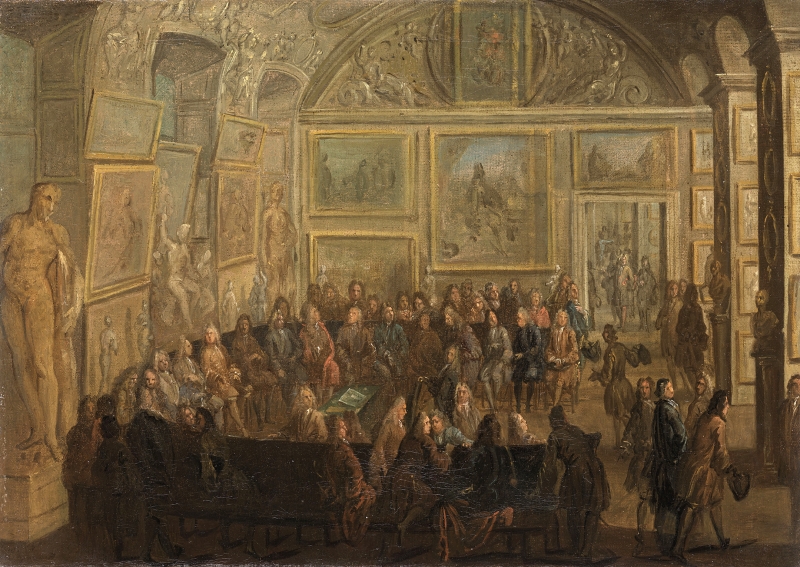
Jean-Baptiste Martin, A Coming together of the Majestic Academy of Painting and Sculpture at the Louvre, c. 1712–21, oil on canvas, 30 10 43 cm (Louvre)
In a room filled to the brim with painting and sculpture, well-dressed men in powdered wigs assemble around a desk-bound while stragglers chat with their neighbors. Jean-Baptiste Martin'south small painting depicts a meeting of the distinguished French art academy without an creative person's tool in sight—only the ornate room situates the scene in the Louvre palace. The selection to not show the artists at work, but rather every bit fashionable gentlemen engaged in sociable intellectual exchange speaks directly to the early on history of the French Royal University.
The Académie Royale de Peinture et de Sculpture (Regal University of Painting and Sculpture) was established in 1648. Information technology oversaw—and held a monopoly over—the arts in France until 1793. The establishment provided indispensable training for artists through both hands-on education and lectures, access to prestigious commissions, and the opportunity to exhibit their piece of work. Significantly, it also controlled the arts by privileging certain subjects and past establishing a hierarchy among its members. This hierarchical structure ultimately led to the Académie's dissolution during the French Revolution. However, the Académie in Paris became the model for many art academies across Europe and in the colonial Americas.
Foundation
This preeminent grooming system for painters and sculptors was founded in response to two related concerns: a nationalistic desire to institute a decidedly French artistic tradition, and the need for a large number of well-trained artists to fulfill important commissions for the purple circle. Previous monarchs had imported artists (primarily from Flanders and Italian republic), to execute major projects. In contrast, King Louis XIV sought to cultivate and back up French artists as office of his grander project of self-fashioning, with art playing a vital role in the construction of the royal prototype.
The Académie quickly rose to prominence, in conjunction with the Ministry of Arts (responsible for construction, ornament, and upkeep of the male monarch's buildings) and the First Painter to the Male monarch—the most prestigious championship an creative person could reach. Two men were integral to the establishment's early history: Jean-Baptiste Colbert, an increasingly influential statesman who acted as the institution's protector, and the creative person Charles Le Brun, who would become on to be both Offset Painter and the Académie's Director. Both men sought to elevate the status of artists past emphasizing their intellectual and creative capacities, and both sought to differentiate members of the Académie—academicians— from order members (guilds were a medieval arrangement that strictly regulated artisans). The Académie, whose members were financially supported by the Male monarch, moved into its permanent location at the Louvre Palace in 1692, further reinforcing the institution's condition. Given such institutional preoccupations, Martin's determination to bear witness artists equally gentlemen socializing rather than as artisans laboring takes on new significance.
Hierarchies
From its inception, the Académie was structured around hierarchy. There were distinct levels of membership that an artist could advance through over time. In art, as well, there was a hierarchy: painting was prioritized over sculpture, and certain subjects were considered more than noble than others. To become a fellow member, artists submitted work for evaluation by academicians, who accepted them at a certain level, based on the kind of subjects they aspired to paint. If they passed this beginning phase, applicants would execute a "reception piece" depicting a subject chosen by the academicians.
The Académie divided paintings into five categories, or genres, ranked in terms of difficulty and prestige:
- History Painting—encompassing highbrow subjects taken from the classical tradition, the bible, or allegories, this type of painting was considered the highest genre considering it required proficiency in depicting the homo body, besides as imagination and intellect to depict what could not be seen. These were often large-calibration multi-figure paintings.
- Portraiture —focusing on capturing likeness, this genre was prestigious, and certainly lucrative, but less and so than history painting. Portraitists were derided for "merely" copying nature rather than inventing (an oversimplification as few portraits were executed entirely from life).
- Genre Painting —depicting scenes of everyday life, this genre included the man effigy merely ostensibly did not represent grand ideas, although many genre paintings had moralizing undertones. Genre paintings were smaller in size than history paintings, further detracting from their prestige.
- Landscapes —consisting of all representations of rural or urban topography, real or imagined, this genre became particularly popular during the eighteenth and nineteenth centuries.
- Still Life Painting —ofttimes indulging in the juxtaposition of colors and textures, these paintings represented inanimate (frequently luxury) objects and drew heavily on the seventeenth-century Dutch tradition of such subjects. While at times other moralizing symbols such as memento mori (reminders of homo mortality) were included, these were not an intrinsic office of the genre, which was considered to require no invention on the part of the creative person (since, they were painting what they could come across).
Training

Benoît-Louis Prévost, later Charles-Nicolas Cochin, "The Schoolhouse of Fine art" ("Ecole de dessein"), planche I. Recueil de planches sur les sciences, les arts libéraux, et les arts mécaniques, avec leur explications, book 3 (Paris, 1763)
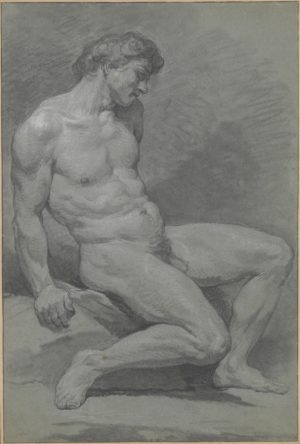
Nicolas Bernard Lépicié, Seated Male Nude Facing Right, mid-18th century, charcoal, stumped, black chalk heightened with white on gray-green newspaper, 50.7 x 34 cm (The Metropolitan Museum of Fine art)
Bookish instruction was centered on drawing (following the precedent of Italian drawing schools established in the sixteenth century). The Académie maintained a rigid curriculum to instruct artists, as recorded in contemporary accounts and depictions. An etching illustrating a 1763 clarification of the "schoolhouse of art" shows how students outset learned to depict past copying drawings and engravings (seen on the left) before moving on to cartoon plaster casts to learn how to translate the three-dimensional course into two dimensions (seen at centre). Students would and then re-create large-scale sculpture (as seen at the correct-about border) before existence allowed to draw the live nude model (as seen in the middle-right portion, slightly gear up back from the foreground). Drawing the male nude grade was the bedrock of the Académie'south curriculum, an essential building block for painters, particularly those destined to produce history paintings. Students produced many unmarried-effigy nude studies, known as académies, such equally this instance from Nicolas Bernard Lépicié. Props could be added later to transform the posed bodies into identifiable figures, as Bernard Picart has done with the drawing Male Nude with a Lamp, where the effigy, with the addition of a lamp, becomes the philosopher Diogenes.
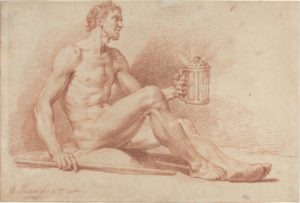
Bernard Picart, Male Nude with a Lamp (Diogenes), 1724, ruby-red chalk on laid newspaper,xxx.9 10 45.vii cm (National Gallery of Art)
In a lively drawing, Charles Natoire depicts himself in a red cape in the left foreground, providing feedback on students' drawings. The majority of students work independently, focused on the 2 nude models in an intertwined pose selected by the supervising professor. The opportunity to written report ii interacting male person bodies was a rarer and more challenging exercise.
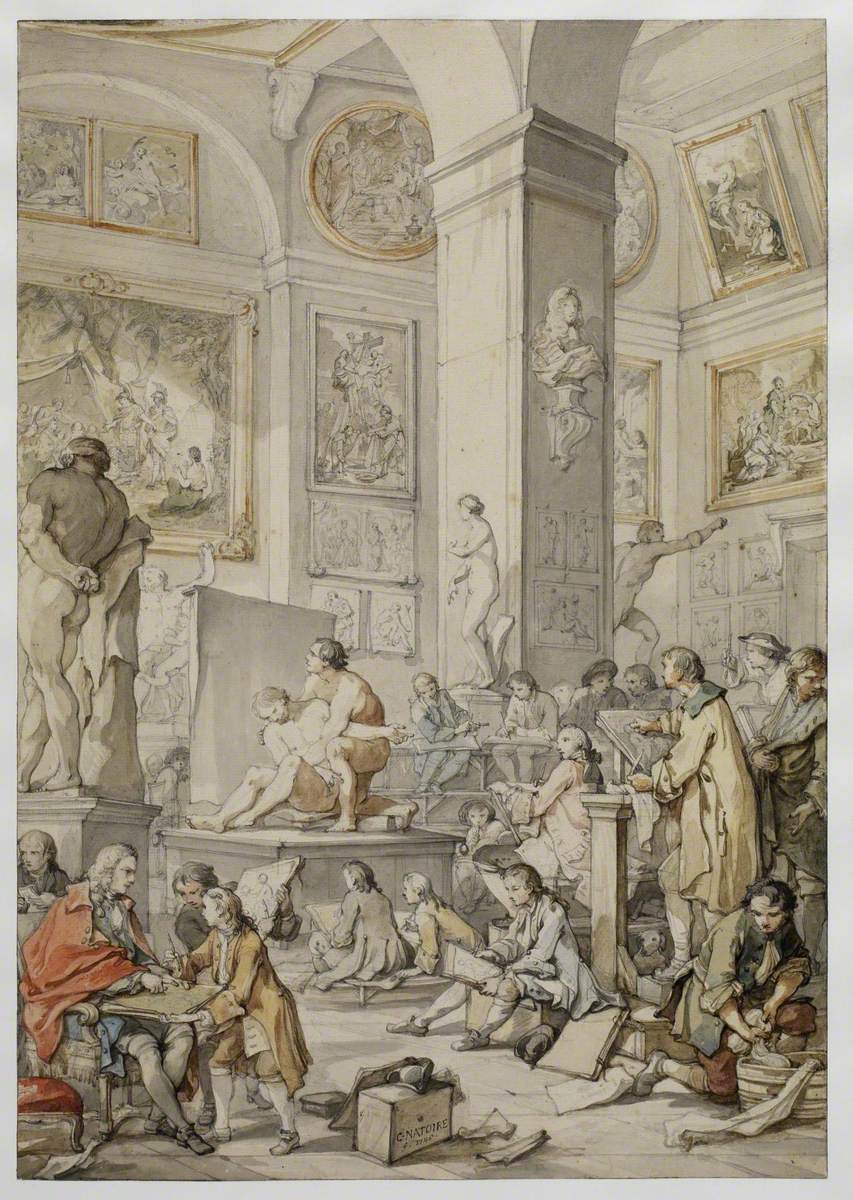
Charles Joseph Natoire, Life Grade at the Royal Academy of Painting and Sculpture, 1746, pen, blackness & brown ink, grayness wash & watercolour & traces of pencil over black chalk on laid newspaper, 45.iii x 32.two cm (The Courtauld Gallery)
Outside of the Académie'southward official spaces, academicians would provide advanced students opportunities to draw nude female models. In improver to supervising drawing teaching, each professor selected students to be role of his studio. This is where artists actually learned to pigment or sculpt by emulating their instructor, often contributing to his large-scale commissions. Studio practices varied, and non all studio members were necessarily enrolled Académie students.
Both academicians and students attended lectures addressing theoretical and practical aspects of artistic exercise, such as the importance of expressions or how to apply paint to ensure longevity. These were offered by professors so-called amateurs. These honorary Académie members were not professional artists but art lovers and "friends of artists"—often from the nobility—who brash artists on questions of composition, aesthetics, and iconography and often championed sure artists, sometimes as patrons or collectors.
The describe of Rome
The classical tradition was central to the Académie's curriculum. In 1666, the Académie opened a satellite in Rome to facilitate students' study of artifact. In 1674, the Académie established the Prix de Rome (Rome Prize), a prestigious accolade that allowed its nearly promising artists to study in Rome for three to five years. While the focus of the French Academy in Rome was facilitating the study of classical antiquity, students also drew after important Renaissance and Baroque artworks, equally seen in Hubert Robert's red chalk drawing depicting an artist copying Domenichino's fresco in a Roman church building.
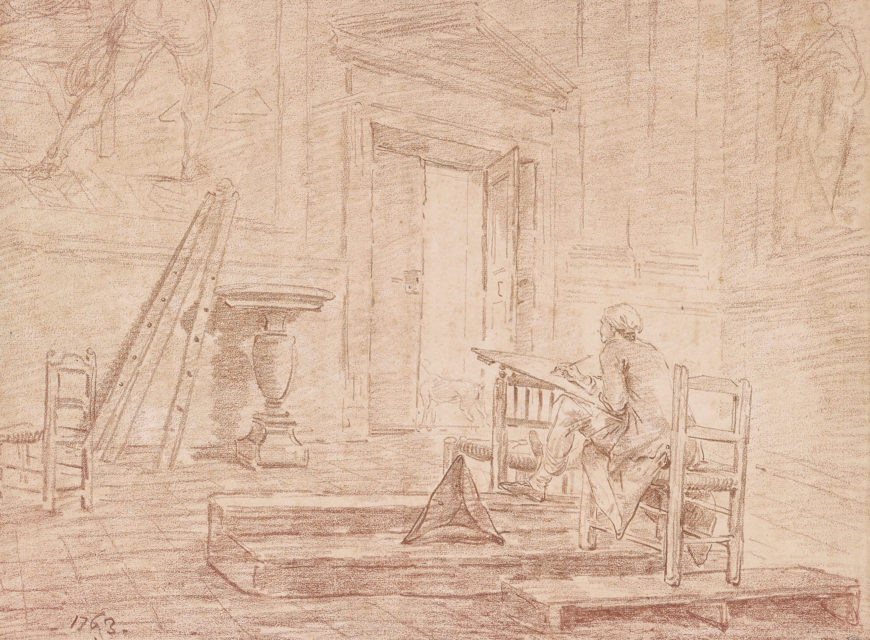
Hubert Robert, Draftsman in the Oratory of S. Andrea, Due south. Gregorio al Celio, 1763, cherry-red chalk, 32.nine x 44.8 cm (Morgan Library & Museum)
While in Rome, these Académie students—called pensionnaires—studied canonical artworks and regularly sent their drawings and copies later on of import works dorsum to Paris to demonstrate their progress. Although non part of the formal curriculum, most artists explored the Roman environs, taking inspiration from the rich mural, various topography, and colorful scenes of peasant life. Important connections were forged in Rome with other artists, patrons, and supporters.
Salons and the rise of public opinion
Beginning in 1667, the Académie established exhibitions to provide members with the crucial opportunity to display their piece of work to a wider audience, thereby cultivating potential patrons and critical attention. Held annually and, afterward, biannually, these exhibitions came to be known as Salons, afterwards the Louvre's salon carré where they took identify after 1725. The Salon became a pregnant space of artistic substitution and an of import opportunity to view art prior to the formation of the public art museum.
Artworks in the Salon were selected by a jury of academicians. Paintings were displayed according to size and genre, with larger works (history painting and portraiture) occupying the more prestigious college levels, every bit can exist seen in an engraving of the Salon of 1785 where Jacques-Louis David's Oath of the Horatii features prominently in the center. With the 1737 introduction of a broader public to the Salon came the advent of public opinion and the emergence of art criticism. The Académie published a booklet that listed the displayed works, organized by the artist'southward rank, called the livret. Art collectors and learned Salon-goers penned opinions analyzing the artistic and intellectual merit of the exhibited artworks; some of these, similar those written by philosopher Denis Diderot, were meant for a pocket-size community of like-minded individuals both in French republic and across, simply increasingly art criticism was printed in newspapers for access by a broader public.
Genders and genres
The Académie was a male space, for the nigh part; some painters accepted female students in their studios, peculiarly in the final quarter of the eighteenth century. Women artists were barred by propriety from studying the male nude figure, a core aspect of Academic training. This rendered them unable to become officially recognized history painters, and they were therefore restricted to genres considered to be less intellectually rigorous. During its 150-twelvemonth long history, the Académie only welcomed four women every bit full members: Marie-Thérèse Reboul was admitted in 1757; Anne Vallayer-Coster was admitted in 1770; Adélaïde Labille-Guiard and Elisabeth Vigée-LeBrun were both admitted in 1783.

This was the artist's reception slice for the Académie. Elisabeth Louise Vigée Le-Brun, Peace Bringing Back Abundance, 1780, oil on canvas, 103 ten 133 cm (Louvre)
Despite their acceptance to the Académie, these women had limited options. Painting primarily still-lifes (similar Reboul), Vallayer-Coster elevated that genre with large-scale ornate compositions. Labille-Guiard led a large studio of female person students and was well-known as a prominent portraitist. So too did Vigée-LeBrun, who pushed the boundaries of genre and her gender by occasionally painting allegories, including her reception piece for the Académie. Familial connections (in the case of Reboul, Labille-Guiard, and Vigée-LeBrun) or royal protectors (in the case of Vallayer-Coster, Labille-Guiard, and Vigée-LeBrun) played vital roles in their success. Without such champions, female artists were unable to penetrate the patriarchal institution of the Académie. Even so, their work and personal lives were subjected to undue public scrutiny and their achievements were often maligned.
Abolition and afterlives
In the 1780s, the Académie came nether assault by members and outsiders for politicizing the distribution of prizes and honors. Its rigid hierarchies, caitiff structures, and rampant nepotism were incompatible with the Revolution'southward core values of Liberty and Equality. Major artists who had benefited from the establishment lobbied for its dissolution. With the overthrow of the monarchy and Louis Sixteen'southward execution, institutions with indelible royal connections were scrutinized and deemed irrelevant. The Académie was abolished on August 8, 1793 past order of the National Convention.
After several years of hardship for artists brought virtually past the erosion of royal, noble, and ecclesiastical patronage during the Revolution, the Directory government revived many of the structures of the Académie in establishing a National Establish of Sciences and Arts (Institut nationale des sciences et des arts, later Institut de France) in 1795. The new arrangement's membership included many former academicians, who reinstated certain aspects of the now-defunct Académie, such as the Rome Prize in 1797. The hierarchy of genres, inculcated in the Académie's members and audiences, remained cardinal to understanding the arts throughout the nineteenth century.
Additional resources
Institut de France
Académie des beaux-arts
Denis Diderot, Salons (tome I – III), Paris: J.50.J Briere Libraire, 1821
The Salon and the Royal Academy in the Nineteenth Century
Laura Auricchio, Melissa Lee Hyde, Mary Sheriff, and Jordana Pomeroy, Royalists to Romantics: Women Artists from the Louvre, Versailles, and Other French National Collections (Scala Arts Publishers, Inc., 2012).
Colin B Bailey, "'Artists Drawing Everywhere': The Rococo and Enlightenment in French republic," in Jennifer Tonkovich et al., Fatigued to Greatness: Master Drawings from the Thaw Drove (New York: Morgan Library & Museum, 2017).
Albert Boime, "Cultural Politics of the Art Academy," The Eighteenth Century vol. 35, no 3 (1994), pp. 203–22.
Thomas Eastward. Crow, Painters and Public Life in Eighteenth Century Paris (Yale University Press, 1985).
Christian Michel, The Académie Royale de Peinture et de Sculpture: The Birth of the French School, 1648–1793, translation by Chris Miller (The Getty Research Constitute, 2018).
Richard Wrigley, T he Origins of French Fine art Criticism: from the Ancien Régime to the Restoration (Oxford University Printing, 1993).
Cite this page as: Daniella Berman, "The Formation of a French School: the Royal Academy of Painting and Sculpture," in Smarthistory, September 2, 2020, accessed May 6, 2022, https://smarthistory.org/royal-academy-france/.
Source: https://smarthistory.org/royal-academy-france/

Post a Comment for "The Royal Academies of Art Were Started to Support and Instruct Students"